Locations




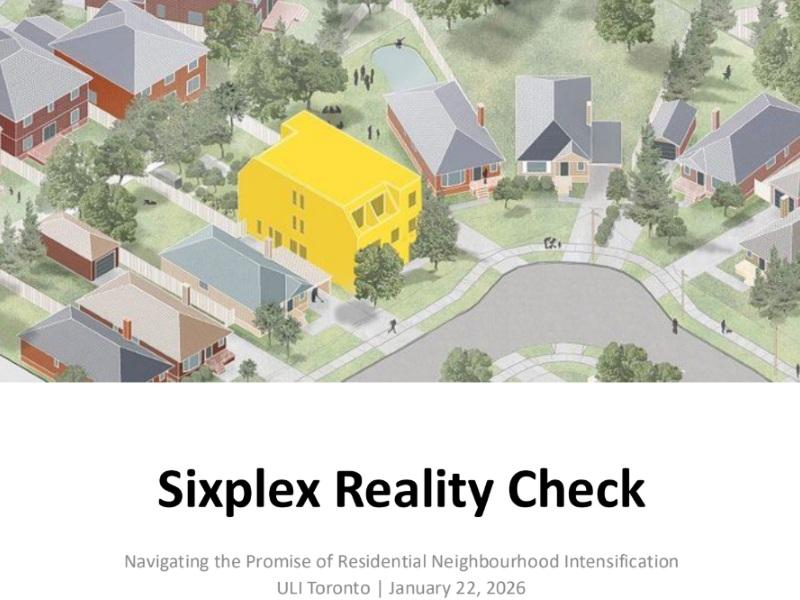
Despite initial excitement about relaxed regulations for developing sixplexes to alleviate Toronto’s housing issues, major economic and design hurdles are hampering delivery, industry experts explained during an Urban Land Institute presentation.
During a Jan. 22 webinar, Toronto-based developers and designers discussed the current viability of sixplexes in the city’s housing market.
In 2025, council moved to permit housing with up to six dwelling units in a single building in many neighbourhoods. A key reason was expanding the supply of missing middle housing – medium-density products to help alleviate housing costs.
The potential is significant. In the Greater Toronto Area, there is potential to develop between 500,000 to 700,000 sixplex units, Jaegap Chung, the founding principal of CLIP Homes, said.
However, most of the panellists painted a dismal picture of the actual sixplex development landscape which exists today.
“In my experience, it’s not working,” Jane Renwick, president of development firm Renwick Corp., said about the economics of sixplex development. “I do think this at best is going to be complementary to missing middle . . . I don’t see it being a real thrust in terms of delivering supply."
A "cottage industry"
Compared to a purpose-built rental building that could be built on the same lot or a smaller multiplex, a sixplex introduces more risk and is harder to develop said Daniel Zimberoff of DEZ Management Corp.
Sixplex development frequently runs into issues with water, electricity, trees and tenant relocations, Chung said. But initiatives on data and mapping can help address those problems, he continued. If the solutions work, Chung anticipates sixplexes will be derisked and more developers will be interested.
The challenging economics of sixplexes were identified as a major roadblock to increased development.
It starts from the land purchase, Renwick said. Developers looking to buy a site for a sixplex are facing high land prices, particularly for choice properties. Then demolition and construction have to be considered, further raising costs. Plus there is no resale market for sixplexes and the projects do not guarantee more hefty returns, she noted.
As Zimberoff put it, “If you’re not a developer, you may not understand that if you build a duplex and build a fourplex, you’re (not) gonna make twice as much... It doesn’t work that way.”
Sixplexes are a "cottage industry," Renwick said, boosting but not leading the future supply of missing middle housing.
She expected an opportunity for more family-sized units to arise out of the relaxed regulations, but has seen very few emerge. The three-bedroom housing in high demand by families is rare; most sixplex units have two bedrooms and are between 650 to 750 square feet.
Single stairwells could support sixplexes

But it wasn’t all gloom on the webinar. Janna Levitt, the founding partner of LGA Architectural Partners, discussed how design choices and regulatory reform could improve the viability of sixplexes.
A single staircase could be part of the solution, she said. The Ontario Building Code requires multiresidential buildings over two storeys above-grade to have more than one means of exiting the building.
But if only one staircase was permitted, it would lead to far more living space, she said. At LGA, Levitt found if a single staircase was allowed in a fiveplex, for example, it would mean an additional 100 square feet per unit.
That provides the space needed for an additional bedroom. It would allow for “better bedroom shapes” and “not just jamming everything into one corner,” she said.
Cities like Vancouver have approved single staircase multiplexes, Levitt said. While fire departments have concerns about potential safety risks, she said the mood has been slowly shifting. Some fire departments are willing to compromise as long as other egress and safety requirements are met.
“If we could have single stairs, if we could have smaller elevators so that a sixplex wouldn’t be faced with having this huge elevator that claws back some of the gains of a single stair” and some reform in the design of non-combustible side walls, it “would be transformational for sixplexes,” Levitt said.
Her vision is to see single staircase regulations in every provincial building code.
Zimberoff said developers are not looking for significant reform to finance sixplexes, but would benefit greatly from a larger basket of lenders providing financing at lower rates.
Renwick urged developers interested in building more sixplexes to discuss the financing options early in the development stage for the sake of efficiency.


 Industry Events
 Locations