
 Locations




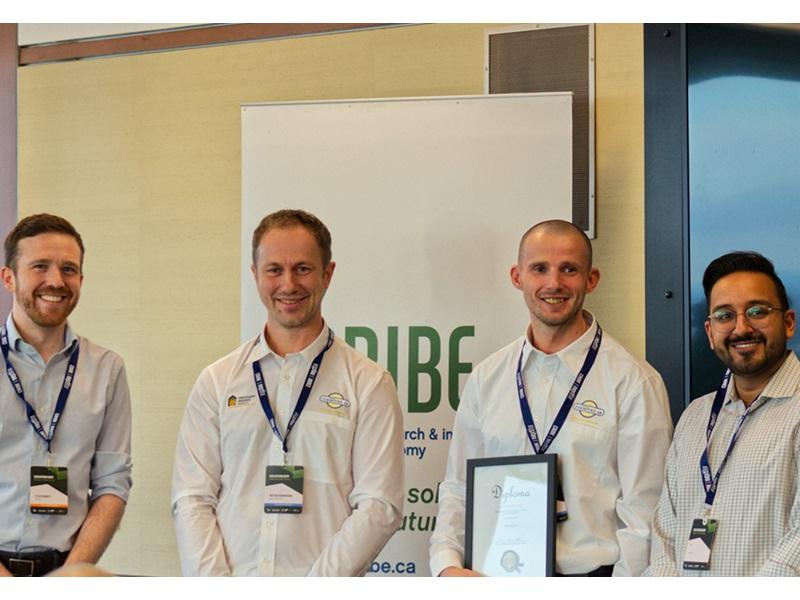
The winner of a competition hosted by Stelumar Advanced Manufacturing Inc. could provide a scalable, sustainable technology the Toronto-based modular homebuilder needs for its upcoming factory in Ontario.
At the event held Feb. 11-12 at the Ontario Investment and Trade Centre in Toronto, Stelumar hosted seven companies which had developed insulation for wood-framed volumetric construction. Stelumar was looking for high-performing, durable, sustainable products that could be sourced from Ontario’s forestry sector and easily integrated into its automated manufacturing.
“The idea is to spur innovation, to look across industries ... there was a focus on bringing European technology and building methodologies to an Ontario market,” Tyler Bennett, Stelumar’s senior manager of planning and operations, said in an interview with RENX Homes about the North American BioBoosters Hackathon.
The winner was Swedish company Svenska Termoträ, with Vancouver-based Plantee Bioplastics Inc. as an honourable mention. Both companies will advance to the next stage, where Stelumar aims to better understand their commercialization potential.
Effective, safe, sustainable insulation
The hackathon is a collaboration between Stelumar, the Thunder Bay-based Centre for Research & Innovation in the Bio-Economy (CRIBE) and the Sweden-based Circular Bioeconomy Arena.
Stelumar is on the hunt for an insulation product that can comfortably fit into the manufacturing process of its modular housing factory, Bennett explained, while reducing carbon emissions compared to concrete and steel.
The company laid out the criteria for an insulation product with high thermal, acoustic and fire performance, made from wood-based and renewable materials which can be sourced from Ontario feedstocks. Circularity was also key, such as the insulation being potentially made from sawmill byproducts or wood fibre waste from Stelumar’s manufacturing process.
When the hackathon was announced in the fall of 2025, there were over a dozen applications. The list was winnowed to seven companies – five from Norway, Sweden and Finland, two from Canada.
“We saw solutions that were well used and common in Europe that we do not (have) here,” Bennett said.
Next steps for the winner
Svenska Termoträ was picked for the “holistic nature” of its solution and because it “hit on a couple different core elements” of the hackathon, Bennett said.
The Swedish company’s wood-based insulation performed well on the key properties, he explained. Svenska Termoträ also has experience with integrating its technology into offsite manufacturing.
Though Plantee’s wood fibre-based insulation did not take first place, it was a close competition, Bennett said. As a consolation prize, he noted the Vancouver-based company shows the potential for long-term collaboration with Stelumar.
As the winner of the hackathon, Svenska Termoträ can apply for up to $100,000 in funding from CRIBE to help with its research and development, plus the next steps in the hackathon.
Both Svenska Termoträ and Plantee can participate in a knowledge-sharing program with Stelumar, where Stelumar will delve deeper into its assemblies and factory layout with the two companies.
Next, Stelumar hopes to visit the facilities of the two companies for further knowledge exchange. CRIBE also plans to work with Svenska Termoträ and Plantee to lay out the availability of pulp supplies in Ontario and determine the feasibility of their manufacturing processes with the material.
Finally, Stelumar and CRIBE plan to assist Svenska Termoträ on putting together a business case so the Swedish company can address major questions. Examples include what an insulation manufacturing facility would look like in Ontario and identifying companies Svenska Termoträ could supply.
Stelumar's plans for factory-built modular housing
The technologies Stelumar is searching for could play critical roles in its ambition to be one of North America’s leaders in manufactured offsite housing.
At a campus being built in Mississauga (where it plans to eventually move its headquarters), Stelumar plans to operate 470,000-square-feet of factory space equipped with robotics and artificial intelligence to produce wall, floor and roof panels, modules ready for transport, and cabinetry. When fully operational, the facility is designed to produce 1,500 volumetric modular homes and panelized wall and floor assemblies for an additional 1,500 homes per year.
Founded in 2024 by Peter Gilgan, the founder of Mattamy Homes, Stelumar plans to supply Mattamy with construction materials. But it will not be an exclusive deal, as Stelumar’s goal is to support Ontario’s housing industry more broadly, Bennett said.
The company’s first project is expected to be a six-storey multifamily building, with the goal of helping to meet high demand for missing middle housing, Bennett said. Stelumar also expects to supply components for detached lowrise homes and townhomes.
The first modules are scheduled to be shipped in the spring of 2027, with the first cabinets shipped this summer.


 Industry Events
 Locations