



 Locations




The homebuilding sector in the Greater Toronto Area (GTA) may be in for another challenging year in 2027, though a number of fluid contributing factors could bring positive change for the market in the second half, according to industry experts.
At its annual Economic, Housing and Political Outlook 2027 on Oct. 29, the Building Industry and Land Development Association (BILD) brought together observers to assess the oncoming year. And while the outlook for 2027 is mixed, with a number of issues representing potential hurdles, some key factors – if they go the industry’s way – could brighten its prospects.
BILD doesn’t usually include the “political” part of the name in its Outlook event, but there’s no escaping the impact politics is having on the economy and homebuilding market conditions.
“The current housing and political landscape is different,” said Dave Wilkes, president and CEO of BILD. “We just went through (Ontario municipal elections on Oct. 26), which saw some very interesting changes throughout the GTA and beyond. We had the fall economic statement from the province (on Oct. 29), and on November 5, we have a federal budget. All of which will influence the way that you work and the way you build homes.”
Add to those influences the U.S. midterm elections which are taking place today, and the ongoing tariff negotiations.
For the homebuilding industry, all of this means change.
'The crisis that we're in'
“We’re obviously in a downcycle period,” added Wilkes. “From a BILD perspective, we wanted to make sure that we recognize, and I'll call it, the crisis that we're in, and utilize it to create what was necessary change, create greater affordability opportunities for the consumers that you're selling homes to, as well as lowering your costs to build.
“Our job is to create more opportunity, to attract investment to our industry, to lower credit risk, to address some of the immigration challenges, including the foreign buyer ban that we have, and to make sure that we have the best data available to government in our industry to make quality decisions.”
BILD is focused on this strategy in its discussions with all levels of government over the next six months, Wilkes said.
Hot-button issues
Multiple hot-button issues are affecting the economy and housing, said Derek Burleton, vice-president and deputy chief economist, TD Bank.
“There are so many things going on,” he said. “It was sort of like Whack-a-Mole, where we had tariffs for a while, and they kind of subsided, then the oil shock and then something else would crop up. But now heading into 2027, it's almost like the issues are just piling on top.”
Uncertainty over tariffs and trade with the U.S. remains, even though both sides suggest a deal may be close.
The impact of tariffs on the Ontario housing industry is significant, the Residential Construction Council of Ontario (RESCON) recently reported. Counter-tariffs imposed on Sept. 8 will add $9,000 to $14,000 to the cost of a typical single-detached home in the province, and $18,000 to $28,000 to a midrise unit. That’s in addition to the $15,000 to $25,000 load that homes were already carrying from measures imposed in March 2025.
The Bank of Canada (BoC) also raised its target for the overnight rate by 25 basis points to 2.5 per cent on Oct. 28. “That wasn’t supposed to happen,” said Burleton. “It's going to have an impact, certainly, in housing.”
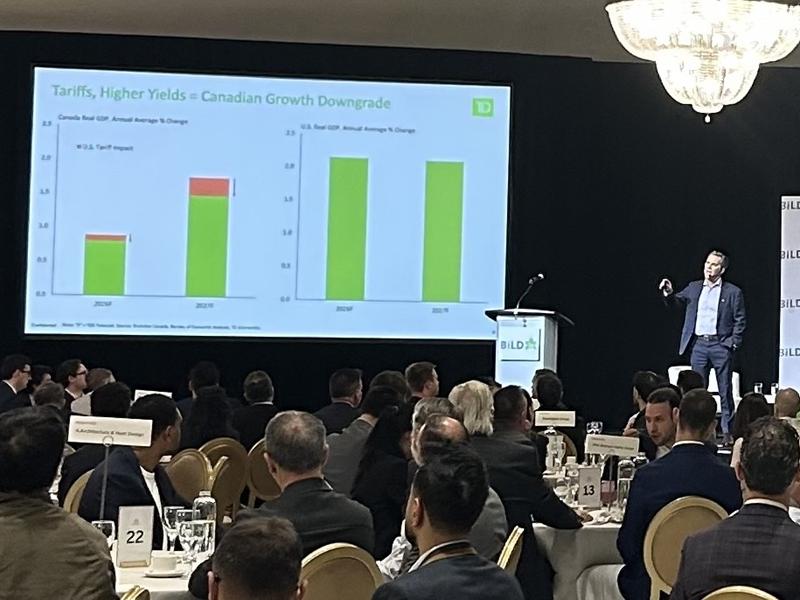
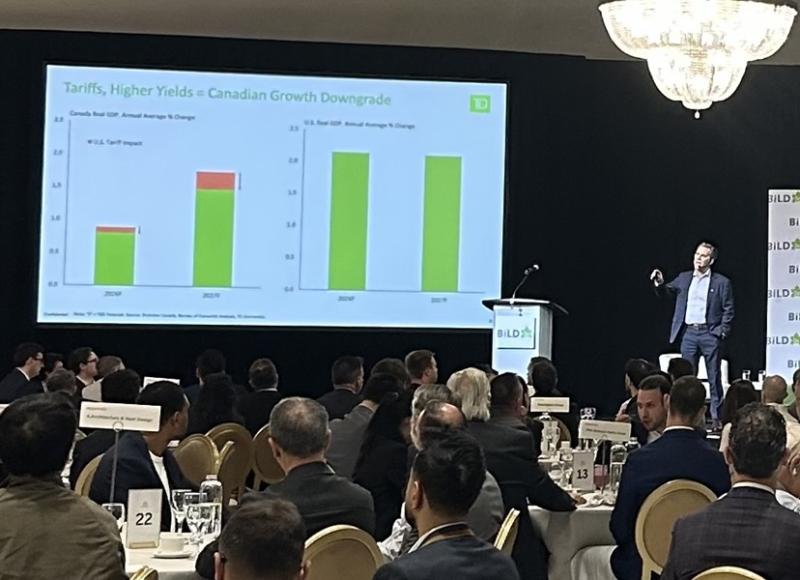
TD recently lowered its growth projection for the Canadian economy because of tariffs and the impact on exports. “This year it will pretty skinny, at sub one per cent on average,” Burleton said.
The good news is that TD sees a jump next year, though a lot of that growth is going to be in business investment and non-residential construction.
Another rate hike, then relief
Burleton said TD foresees another rate hike by BoC on the horizon, to contain inflation risks, though likely in January and not the next announcement on Dec. 9.
“Beyond that, we don't have them hiking anymore,” he said. “We actually have them on reverse, and could see a cut by the end of next year.”
Private services such as manufacturing and non-residential construction are supporting the Ontario economy at the moment, Burleton said, “but for 2028, I'm hoping the homebuilding industry begins to join the party to a greater extent.
“We do still see pent-up demand, but it's just going to take a while for that to bear fruit, with the affordability challenges and higher rates.”
Ontario housing outlook to brighten in second half of 2027
TD’s initial forecast was for the housing market to improve in Ontario in the first half of 2027, with resales leading the way, but “I think we're going to be pushing that back a bit to reflect the starting point of higher rates, and it may be more of a second half story next year and into 2028,” Burleton said.
Inventories in the condominium segment are coming down, thanks in part to recent government policies such as the HST rebate. Burleton said he sees more upside in single-family homes and rentals next year.
With a landscape filled with challenges and uncertainty, homebuilders in Ontario and elsewhere in Canada should use this time to make better and more data-driven decisions about what to build.
Mathieu Laberge, chief economist and senior vice-president, housing insights, at Canada Mortgage and Housing Corp., challenged the housing industry (as well as policy makers, municipalities and lenders) to develop a more agile and responsive system to respond more quickly when conditions change.
Instead of focusing building decisions on recent past sales, the industry should look further forward to three, five and 10 years coming, he suggested.
“We need to start thinking about the market that doesn't exist yet,” he said.




 Industry Events
 Locations

