Locations





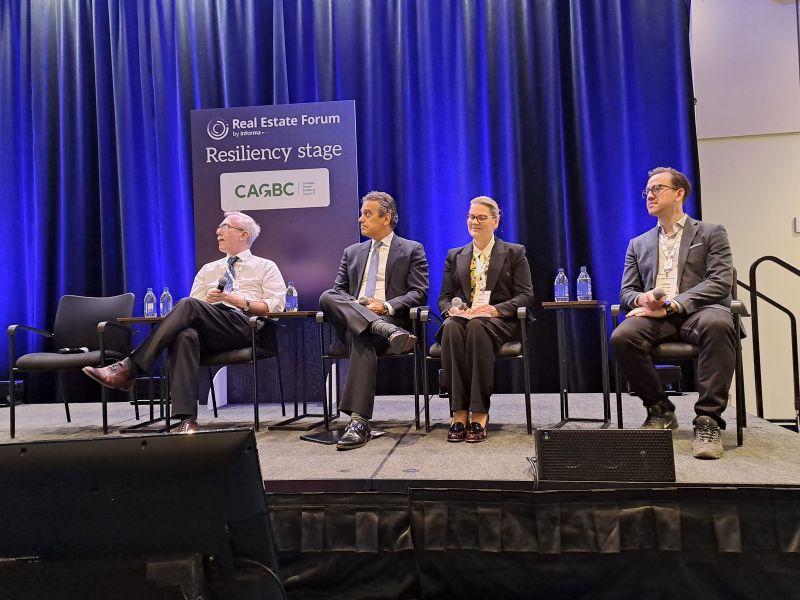
Partnerships and innovations will be vital to scaling-up the availability of affordable housing across Canada, panellists speaking at the Toronto Real Estate Forum (TREF) said.
As demand for affordable housing has surged across much of the country, industry experts at the Dec. 3-4 event in Toronto discussed how the private and public sectors can introduce more supply.
During a presentation about the role of Build Canada Homes (BCH), the newly formed agency, its CEO Ana Bailão emphasized how it will serve as an industry partner to catalyze the “industrialization of how we build housing” and “modern methods of construction.”
Innovation on technology, regulations and business models were identified by a separate panel on scaling affordable housing.
“The thinking that we need to solve this problem has to be very different than the thinking that was used when we created this problem,” George Carras, the founder and CEO of Toronto-based R-LABS Canada Inc., said.
If investment to boost affordable housing supply is not increased, the consequences will be dire, Bailão warned.
“How much are we going to spend on people if we don’t have the transitional housing that we need, and people clogging our (emergency rooms) instead of being housed properly?” she said in response to a question from fellow panellist Michael Brooks, CEO of REALPAC.
The Build Canada Homes mandate
BCH was created to deliver “a new way to deliver housing,” Bailão said. Private players are unlikely to produce “deeper affordable” housing, so the agency is focusing on facilitating these forms through partnerships with both the for-profit and non-profit sectors.
The agency defines affordable housing as “spending less than 30 per cent of a household's before-tax income on housing costs.”
“We can come in with equity... we can come in with grants, we can come in with guarantees, we can come in with loans,” Bailão said, summarizing some of its potential contributions.
The intent is to create a project pipeline and de-risk projects, allowing for factories that can build housing cheaper and faster.
To create internal capacity, BCH will first look at projects that can start construction within the next 12 months. Ultimately, BCH looks to create a portfolio approach to establish a project pipeline, Bailão explained. “The certainty of the funding is extremely important.”
BHC will consider innovation in the projects it supports, and has already received proposals for new financial models and use of mass timber.
Brooks asked Bailão how BHC will make manufactured housing viable, against industry concerns such as needing a “big subdivision’s-worth of demand.” She replied BHC will identify roadblocks in the sector, such as how off-site construction is financed, and work with the federal government to remove the barriers.
Sharing, collaboration critical to efforts

To scale up the creation of high-quality and climate-resilient affordable housing in Canada, Aled ab Iorwerth, the deputy chief economist of the Canada Mortgage and Housing Corporation, suggested standardization of regulations based on a proper cost-benefit analysis.
He also noted the need for greater digitization and technology adoption to achieve scale.
New business models will be needed to instill confidence, said Deana Grinnell, the executive vice-president of real estate at the Canada Lands Company. Risk-sharing will be critical to support the large, upfront investments needed to boost affordable housing supply, she said.
Canada will need an innovation policy framework to incentivizes early adoption when novel solutions are presented, Carras suggested. If a property owner has the opportunity to intensify a site with four units, with the local government’s blessing, “then we’ll get that behaviour to go.”
Collaboration and partnerships are key to introducing more affordable housing by reducing risks, Jeremy Reeds, the president of Ottawa- and Toronto-based Windmill Developments, said.
Windmill, for example, is sharing its insights on using geothermal energy in buildings with industry peers. Now it is far more common to see buildings tap into this energy source, he said.
“The only way the industry is going to keep changing is if we keep sharing everything that we learn through these pains, what works, what doesn’t work,” Reeds said.
With greater attention put on factory-built homes to address Canada’s housing situation, new project financing models will also be required, Carras said. In Canada, the housing sector is used to financing models with low overhead costs and high project costs. By contrast, factory-built housing demands high fixed costs, but low output costs.
To bridge the gap, R-LABS arranged for three Canadian banks and one Swedish bank to discuss how a change of mindset could be achieved.
“I think we’re in the early innings of some of this novel innovation, and it’s coming in all different places, and the business model is the ballgame,” Carras said.



 Industry Events
 Locations