
 Locations





When British Columbia passed Bill 44 in 2023, requiring all municipalities in the province to permit up to three or six units on single-family lots as of right, it was described as revolutionary.
And in policy terms, it was. Sightline Institute notes the changes were a first for "rapid legalization of apartments and multiplexes in North America."
But on the ground, the pace tells a different story.
"We're very familiar with how long it takes for policy and zoning reform to actually lead to delivery," accordint to Akua Schatz, owner and partner at Smallworks, a Vancouver-based design-build firm specializing in small-scale infill housing — laneway homes, coach houses and now multiplexes. The company has built more than 500 units in 18 years.
"You can have all the enabling tools in place, but it will take time for builders and developers," Schatz noted.
The gap between what zoning now permits and what's actually being built reflects a set of issues going well beyond policy: financing instruments that haven't kept pace, municipal fee structures that undercut project viability, construction economics that leave the middle ground between a single-family home and a large apartment building largely unserved and a market that's shifting beneath developers' feet.
The financing gap
Of the obstacles Schatz identifies, financing is among the most stubborn. She notes lending tools have historically been built either for large-scale developers doing 20-plus units or for individual homeowners doing a kitchen renovation.
A homeowner who wants to build a fourplex on their existing lot — potentially a $2-million construction project — falls between those categories.
"There aren't really the same lending instruments online for construction lending at that size," Schatz said. She notes VanCity has developed an instrument aimed at homeowners acting as small-scale developers, but describes it as the first of its kind.
A typical homeowner candidate — someone in their 60s, perhaps with their land paid off but on a fixed income — may not qualify for the size of loan the project requires, even with significant land equity.
"Most lenders haven't been leveraging the land value on this," she said. "And that's something that can help bridge the gap. It's not as simple as just policy and zoning."
Case in point: Toronto
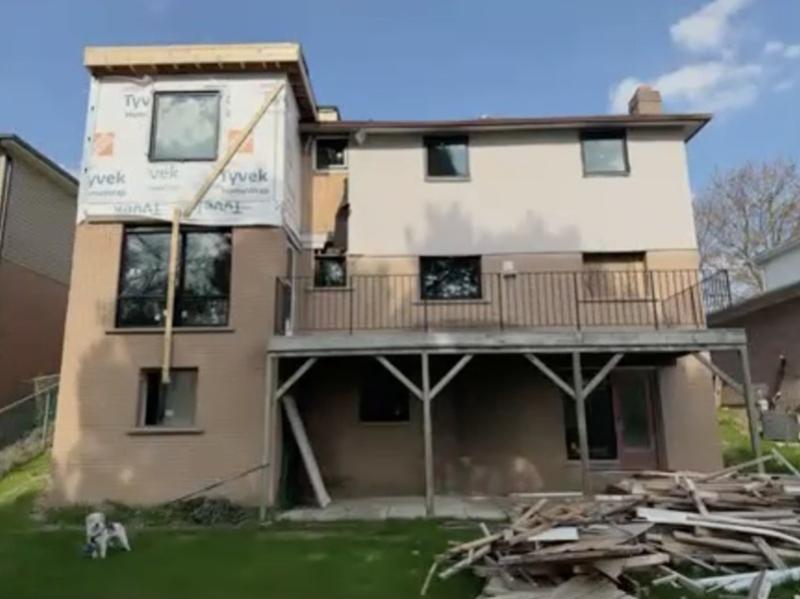
The experience of Davis Bae, a Toronto realtor converting a detached home into a fourplex plus garden suite, illustrates the financing maze in practice.
Bae purchased his property for approximately $1.175 million and has been funding construction out of personal cash and a home equity line of credit while working to secure a $900,000 construction loan from a private or alternative lender.
"It's a very stressful time," he said, describing the process of assembling second-position construction financing. Bae had to commission a $5,300 commercial appraisal — required for any project of five units or more — to demonstrate projected post-completion value to potential lenders. "Every day there's a new challenge," he said.
Bae had initially considered applying for financing through the CMHC MLI Select program, which focuses on "affordability, accessibility and climate compatibility," but found the process too complex. He estimates borrowers need to have roughly 35 to 40 per cent of a project's value in assets, putting the program out of reach for many would-be small developers.
Municipal fees and disincentives
Even where policy frameworks are supportive, individual municipalities have found ways to add cost. Schatz describes a situation in the City of North Vancouver where adding a secondary unit triggered a requirement to install street lighting — roughly $50,000 — plus a fire hydrant at the owner's expense.
"They're putting in place these things to almost slow down what they see as a flood," she said.
In practice, Schatz argues, policymakers are overestimating the likely pace of uptake.
Based on her experience, even under favourable conditions, a one per cent annual turnover of housing stock is huge. "A neighbourhood is going to take 30, 40, 50 years to change over to something significantly noticeable . . . This is incremental," she said.
She contrasts this example with jurisdictions she considers more functional. Vancouver, for example, has smoothed out its permitting process to the point of reasonable predictability — about three months to a building permit in her firm's current experience. Burnaby is improving. Others are still working through the learning curve.
A shifting market
The broader question of timing hangs over the sector. Apartment vacancy rates are rising across Canada, and economic uncertainty tied to trade policy has introduced hesitation among builders who were already navigating thin margins.
But Schatz is careful not to conflate a softening condominium market with a lack of demand for ground-oriented missing middle housing.
"Rental towers and condos downtown serve a very different need than multiplex developments in residential neighbourhoods near schools, parks and transit," she said. "We're in a cycle. You can't say missing middle doesn't work just because there's condo vacancy."
Bae, who plans to hold his completed fiveplex long-term as a rental property, said demand in his neighbourhood remains steady. He expects to fill units without difficulty once construction is complete, targeting a fall finish.
His advice for anyone considering a similar project without a construction or real estate background: hire an experienced multiplex builder and a lender who specializes in the product type. "Let the professionals do the work," he said. "Don't get yourself stressed so much. Just focus on the financing."
What's next
Both sources agree the numbers will grow, but not quickly. Schatz points to Vancouver's own incremental history as a template: basement suites legalized in the early 2000s, laneway homes in 2009, duplexes in 2018 and now, multiplexes.
Each step built familiarity and market capacity for the next, she points out.
The jurisdictions that skipped those steps and moved directly from single-family-only zoning to permitting sixplexes are still building that foundation, she added, and eliminating that single-family zoning is "a fundamental shift in the way we look at how our residential neighborhoods are built up."
"We can't underestimate how change takes time . . . (but) as we unclip the barriers and find smoother pathways," Schatz said, "the uptake will come."


 Industry Events
 Locations